
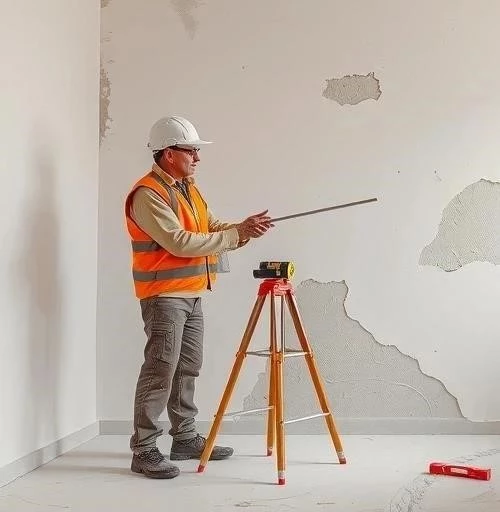
A new apartment may look like a blank page, but its walls can tell a wilder story: a corner leans, a seam bulges, and a straightedge reveals a miniature landscape. Before buying materials, measure the wall deviation—замер перепадов. This first step turns guesswork into a plan and helps decide whether plaster or drywall is the smarter fix.
Measure before you choose
Check each wall at several heights and across its width. A laser level projects a clear reference plane; a builder’s level and plumb bob are useful where a laser cannot reach. Hold a long plastering straightedge against the surface, mark gaps, and use a tape measure to record the largest difference. A putty knife is for later repairs, not for measuring. These tools reveal whether the surface has isolated bumps or a general lean.
Match the method to the wall
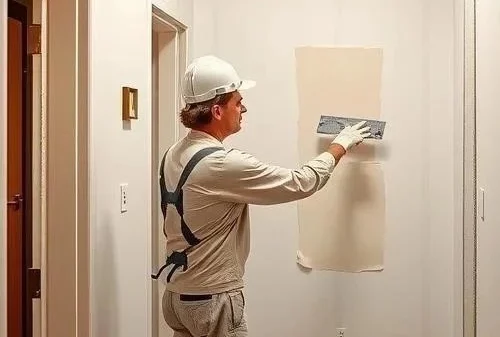
For modest unevenness, plaster is usually space-saving. Choose gypsum plaster for dry rooms and cement plaster where moisture resistance matters. Clean loose material, repair cracks, and prime the wall. If the plaster layer is thick, reinforce it with mesh where the system requires it. Set plaster beacons in one plane, checking each with a level and straightedge; then apply the mix and draw the rule upward. Beacon installation is not decoration: a rushed setup simply reproduces the wall’s crookedness in a tidier form.
When there are major deviations, a thick coat can become heavy, expensive, and slow to dry. A drywall frame creates a predictable plane and can hide wiring, though it takes away some room. Dry plaster—bonded drywall sheets without a frame—may suit a sound, stable wall, but it cannot correct every severe defect. Check the substrate and the manufacturer’s instructions before choosing.
Budget for the whole job
Calculate plaster consumption from the average layer thickness, not the deepest hollow alone; follow the bag’s coverage rate and allow a sensible reserve. Tool choice also affects speed: a laser helps align many beacons, while a long straightedge is essential for drawing plaster flat. Include preparation, primer, mesh, delivery, and finishing when comparing the cost of wall leveling. The cheapest material is not always the cheapest result.
In short, leveling walls in a new building starts with measurement, not a trowel. Select the method after checking the plane, moisture conditions, and usable floor area. The practical vocabulary for this job includes: выравнивание стен, стены в новостройке, большие перепады стен, неровные стены, кривизна стен, замер перепадов, лазерный уровень, строительный уровень, отвес, правило для штукатурки, рулетка, шпатель, штукатурный маяк, установка маяков, гипсовая штукатурка, цементная штукатурка, штукатурная смесь, гипсокартон, каркас для гипсокартона, сухая штукатурка, толщина штукатурного слоя, черновая отделка, подготовка стен, грунтовка стен, армирующая сетка, расход штукатурки, выбор инструмента, технология выравнивания стен, стоимость выравнивания стен.

6 Comments. Оставить новый
This is the sort of practical advice that can save both money and a few dramatic sighs. Measuring first may not feel glamorous, but neither does discovering your new plaster has inherited the wall’s original personality.
The reminder that badly placed beacons can neatly preserve a wall’s crookedness is wonderfully memorable. It captures the whole lesson: precision at the beginning matters more than confidence at the end.
A helpful guide with a subtle message: the best renovation tool may be restraint. Measure carefully, choose the method that suits the wall, and don’t ask one thick coat to solve every problem.
I like the idea that a wall is a landscape before it is a surface. The straightedge becomes a tiny horizon line, turning renovation from guesswork into a kind of topography.
A laser level projecting a reference plane sounds like giving a crooked room a glimpse of its better self. Clear, useful guidance for anyone about to negotiate with an unruly wall.
The comparison between plaster and drywall is refreshingly grounded in trade-offs, not magic fixes. Every wall gets its own diagnosis—and apparently, its own treatment plan.