
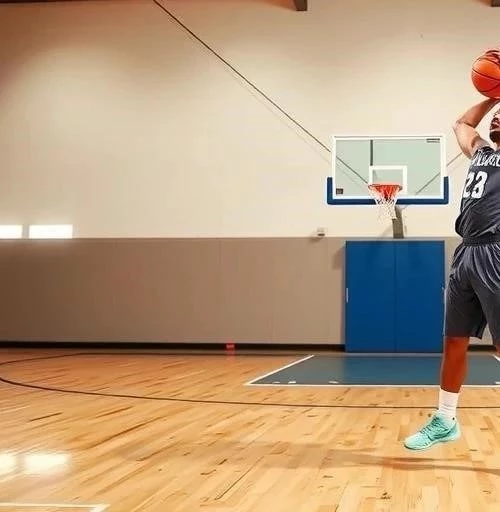
A reliable basketball shot is not simply a matter of arm strength. It comes from repeatable balance, coordinated movement and a relaxed release. Learning sound mechanics matters because a consistent technique gives you a better chance of scoring under pressure—and makes it easier to correct misses.
Build a balanced stance
Face the basket with your feet about shoulder-width apart. Place the foot on your shooting-hand side slightly ahead, and turn your body just a little toward the hoop. Bend your knees and keep your weight evenly balanced on the balls of your feet. Avoid leaning backward or rocking from side to side: an unstable base makes the ball’s path harder to control. Your stance should feel comfortable enough to repeat, not rigid.
Hold the ball with both hands
Rest the ball on your shooting hand, spreading your fingers so the palm does not press tightly against it. Your fingers should point generally upward, and there should be a small gap between your palm and the ball. Place your guide hand lightly on the side. It steadies the ball but should not push it during the shot. This separation is important: the shooting hand supplies direction and force, while the guide hand prevents unwanted wobbling.
Align your shooting motion
Bring the ball comfortably in front of your body, then lift it toward your shooting side. Keep your elbow under the ball, roughly in line with your wrist and the basket. Do not force your arm into an uncomfortable position; a natural, repeatable alignment is more useful than copying somebody else’s exact stance. Look at a specific target, such as the back of the rim, rather than following the ball with your eyes.
Use your legs and release smoothly
Start the shot by bending your knees, then extend your legs as your shooting arm rises. The movement should flow upward rather than become a sudden shove. At the top, straighten the elbow and snap the wrist, letting the ball roll off your fingertips. Aim for a high, soft arc: it gives the ball a better angle into the hoop. A forceful, flat throw may travel farther, but it is usually less forgiving.
Hold your follow-through
After release, keep your wrist relaxed and your fingers pointing toward the target, as if reaching into the rim. Hold this position briefly. It helps you notice whether your hand finished straight or twisted sideways. The guide hand should remain relaxed; if it flicks forward, it may be influencing the shot.
Practice with purpose
Begin close to the basket and take controlled shots, focusing on balance, alignment and a clean release. Move farther away only when your form stays consistent. Practise from several spots, and track whether misses fall short, long, left or right; each pattern offers useful feedback. Avoid rushing through repetitions just to make more attempts.
In short: balance first, guide hand quiet, legs involved, wrist relaxed. Consistent fundamentals—not extra force—are the soundest route to a dependable shot.

7 Comments. Оставить новый
I like that the advice discourages forcing an uncomfortable arm position just to imitate someone else. Players have different builds, so focusing on a repeatable, natural motion is more reasonable than insisting everyone use identical mechanics.
This is clear and accessible for newer players, while still offering details experienced players can check in their own form. The emphasis on comfort and repeatability is sensible because reliable mechanics are easier to maintain under pressure.
The advice to select a specific target is a helpful reminder that good shooting involves attention as well as mechanics. Pairing that focus with a balanced stance and repeatable release should make practice more purposeful.
This is a practical overview of shooting fundamentals, and the emphasis on a balanced stance is useful. A stable base gives players a consistent starting point, making it easier to tell whether a missed shot came from alignment, release or another part of the motion.
The explanation makes a strong case for treating a jump shot as a coordinated movement rather than an arm-only action. I especially appreciate the distinction between the shooting hand and the guide hand, since that can help players identify why a ball is drifting sideways.
The focus on a smooth sequence from the legs through the shooting arm is valuable. It gives beginners a useful way to think about generating power without turning the shot into a sudden, tense shove.
The article clearly explains why the guide hand should steady the ball without pushing it. That detail is easy to overlook, but unwanted pressure from the guide hand can affect direction and make a shot less consistent.