
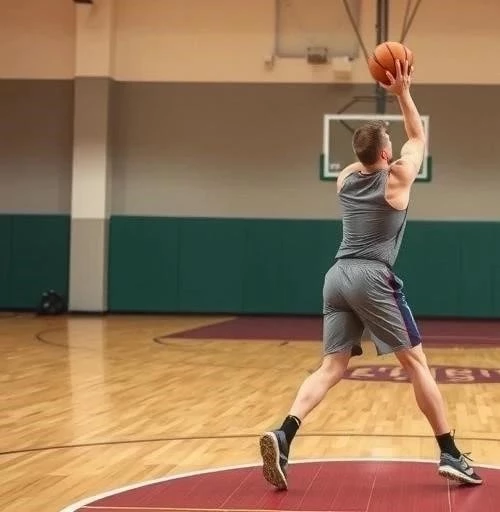
A good shot is not a shove toward a distant hoop. It is a small, repeatable piece of choreography: balanced feet, a steady guide hand, a confident shooting arm, and a soft finish. Build that sequence close to the basket first; distance comes later. Your aim is not to make every attempt spectacular, but to make your motion reliable enough to trust when the game gets loud.
Find your starting position
Face the basket with your feet about shoulder-width apart. If you shoot right-handed, place your right foot slightly ahead; reverse the arrangement if you shoot left-handed. Keep your weight balanced over the middle of your feet, knees comfortably bent, and shoulders relaxed. Your body need not point perfectly straight at the hoop—choose a stance that feels natural and lets your shooting arm travel freely. Before each attempt, take a calm breath and settle into the same position.
Let the shooting hand lead
Rest the ball on the pads of your shooting hand, not deep in your palm. Spread your fingers comfortably, with the index and middle fingers underneath or near the center of the ball. The other hand rests lightly on its side as a guide. It steadies the ball; it does not push it. Lift the ball smoothly toward your forehead, keeping your elbow under the ball as much as your natural motion allows. Avoid squeezing: relaxed fingers give you a cleaner release.
Make one smooth motion
As the ball rises, bend your knees slightly, then extend your legs and shooting arm in one coordinated movement. The power starts from the floor and travels upward; your arm and wrist provide direction and touch. Release the ball near the top of your reach, without forcing a jump. Snap your wrist gently so the ball rolls off your fingertips, then hold your follow-through—wrist relaxed, fingers pointing toward the target—as if reaching into a cookie jar on a very high shelf. Your guide hand should come away without spinning the ball sideways.
Give the ball a friendly arc
Imagine the ball travelling on a soft rainbow rather than a flat line. A higher arc gives it a wider opening into the rim. Look at the center of the hoop, or choose a small target on the backboard when shooting from an angle close to the basket. From either side, the little square can help you judge a gentle bank shot. Keep your eyes on the target through the release; don’t duck your head to watch your feet.
Practise like a patient inventor
Begin close to the hoop, where you can concentrate on hand placement, balance, and follow-through instead of trying to launch the ball. Take several controlled shots from one spot. When your form stays consistent and you make a few in a row, step back a little. Work from different angles, then practise free throws and game-like shots. Use the same basic mechanics at each distance; add power through your legs rather than changing into a two-handed heave.
A simple practice loop
- Take five close shots, checking your stance and release.
- Move to another angle and repeat, aiming for a soft arc.
- Step farther away only when your motion remains smooth.
- Record makes and misses. Notice whether the ball falls short, long, or to one side.
Common snags
If the ball travels sideways, check whether your guide hand is pushing. If shots fall short, use more leg drive and practise nearer the basket. If they sail long, soften your effort instead of tightening your whole body. Don’t chase speed before control: a rushed shot often turns neat mechanics into guesswork. Misses are useful clues, not verdicts. Adjust one thing at a time, and ask a coach to check your form if something feels uncomfortable.
Every clean basket begins before the ball leaves your hand. Stand balanced, lift smoothly, finish with your fingers, and give the shot a forgiving arc. Repeat the motion patiently, and the hoop starts to feel less like a target across a canyon—and more like a familiar doorway.
5 Comments. Оставить новый
This reads like a tiny choreography lesson for the hands and feet. I appreciate the reminder that a natural stance matters more than posing like a perfectly aligned statue.
The “cookie jar” image is wonderfully memorable—it turns follow-through into something you can almost feel. A practical guide with a little kitchen magic.
The explanation of the guide hand is especially useful. It gives that non-shooting hand a clear job description: support the ball, then gracefully leave the stage.
I like how this makes shooting sound less like a heroic leap and more like a rhythm you can rehearse. The calm-breath reminder may be the quietest tip, but it could be the one that helps most when the gym gets noisy.
A refreshing approach: build trust in the motion before chasing distance. It makes improvement feel less like hunting for a miracle shot and more like learning a reliable little song.