
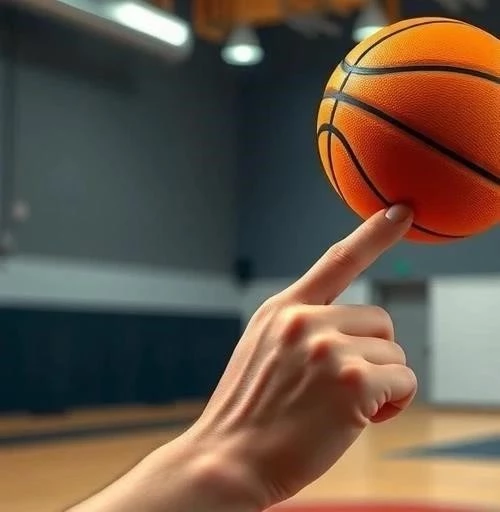
Spinning a basketball on one finger is a balance skill, not a test of strength. The ball stays up because it rotates around a point of support. Learning the motion takes practice: first develop a stable spin, then make gentle contact with the ball, and finally balance it on your fingertip.
Choose a suitable ball and space
Use an inflated basketball with a clean, dry surface. A ball with noticeable grooves can be easier to control because the lines help you find its center. Practise in an open area, away from lamps, windows, people, and breakable objects. Wear comfortable clothing and remove rings or other items that could catch on the ball. If your finger or wrist hurts, stop and rest.
Find the balance point
Hold the ball with both hands and look for the point at the center of one of its circular panels. This is a useful target for your fingertip. A ball balanced near its center is easier to keep steady than one supported far to the side. Start with the ball held close to your body, around chest height, so that a drop is easy to control.
Practise spinning the ball
Place the ball in your non-dominant hand, with your fingers spread beneath it. Set your dominant hand against the side of the ball. Use a quick, smooth push and a flick of the fingers to send the ball rotating. The push should give the ball spin rather than launch it high into the air. Practise catching it with both hands after each attempt. Aim for rotation that is fast, even, and close to vertical.
Beginners may find it easier to start with the ball on a flat surface. Roll it gently, then use your fingertips to make it spin. This helps you learn how the ball moves without having to manage a high toss at the same time. Keep practising the spin separately until you can produce it consistently.
Move your finger under the ball
When the ball is rotating steadily, toss it only a short distance upward. As it rises, move your index finger toward the center of the ball’s underside. Keep the finger fairly straight, with the tip pointing upward. Make light contact; do not jab or push hard. Try to place the fingertip beneath the ball rather than against its side. The ball should continue rotating while resting on the finger.
If using your index finger feels awkward, you can try your middle finger. Use whichever finger gives you comfortable control. Keep your free hand nearby at first, ready to catch the ball safely. Do not attempt to catch a falling ball with a bent or outstretched finger.
Keep the spin steady
Watch the ball’s center and make small adjustments beneath it. If it leans to one side, shift your hand slightly in the same direction to get back under its center. Keep your wrist relaxed and your arm steady. Avoid large corrections, which can push the ball off balance. When the spin slows, a light tap near the ball’s side with your free hand can add rotation. Practise short balances before trying to keep the ball up for longer.
Common problems
- The ball wobbles: The spin may be off-center or too slow. Practise a straighter, quicker spin before adding the finger balance.
- The ball slips off: Your fingertip may be too far from the center, or your hand may be moving suddenly. Aim for the center and make smaller adjustments.
- The toss is difficult to control: Use less height. A low, predictable toss is easier to meet with your finger.
- Your finger becomes sore: Take a break and check your technique. Do not force the ball to balance on a painful finger.
Practice plan
Work in brief sessions. Begin with several minutes of spinning and catching, then try a few low tosses and short balances. Rest between attempts, and increase the duration gradually. Consistency matters more than keeping the ball up for a long time immediately. A controlled spin, a centered fingertip, and patient repetition are the main elements of the trick.
1 Comment. Оставить новый
The article gives beginners a clear, practical progression, separating the spin from the balancing step. The reminders to practise in a safe space and stop if discomfort occurs are useful.