
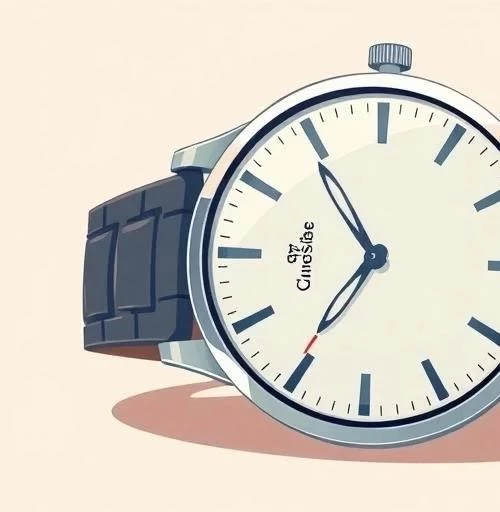
Watch is one of those English words that keeps more than one eye open. It can tell the time, follow a moving scene, guard a quiet doorway, or warn you to be careful. Its meaning depends on the company it keeps: the words around it act like little clues.
A watch you can wear
As a noun, a watch is a small timekeeping device worn on the wrist or carried in a pocket. A classic watch has a face and hands; a digital watch shows numbers. A smartwatch adds modern tricks, such as displaying messages, counting steps, or tracking a workout. In a sentence: “She checked her watch before the train arrived.”
A watch is not quite the same as a clock. A clock usually stays in one place—on a wall, desk, or tower—while a watch is designed to travel with its owner. Think of the clock as a lighthouse and the watch as a tiny timekeeper sailing beside you.
To watch: look with attention
As a verb, to watch means to look at something carefully, often for a while, especially when it is moving or changing. You can watch a film, watch birds, or watch the rain slide down a window. It suggests focused attention, not just a passing glance.
Compare these common verbs:
- See means that your eyes notice something: “I saw a flash.”
- Look means that you turn your eyes toward something: “Look at the sky.”
- Watch means that you keep looking, paying attention as something happens: “We watched the clouds gather.”
So you might see a football match on television, but you watch it if you follow the action. The distinction is not a strict rule in every sentence, but it is a useful guide.
To watch over: protect and keep an eye on
Watching can also be a job—or an act of care. A lifeguard watches swimmers. A nurse watches a patient’s condition. A parent may watch over a sleeping child. The phrase watch over means to look after or protect someone or something.
There is a related noun in “The soldiers stood watch.” Here, a watch is a period of duty spent guarding or observing. In older seafaring language, it could also mean a scheduled shift aboard a ship. The same word links a wristwatch, which marks the hours, with a person who stays awake through them.
Useful phrases
- Watch out! — Be careful; danger may be near. “Watch out for that bicycle!”
- Watch for — Stay alert for something expected. “Watch for an email from the school.”
- Keep watch — Remain alert to guard or observe. “They kept watch until dawn.”
- Watch your step — Be careful where you walk; it can also mean to act cautiously.
- Watch your words — Choose what you say carefully.
A quick grammar note
For the present simple, use watch with I, you, we, and they, but watches with he, she, or it: “They watch the game”; “He watches the game.” The past tense is watched: “We watched the sunrise.” After watch, English often uses an object plus a verb without to: “I watched the cat jump.” This can suggest that you saw the whole action.
The idea behind the word
At its heart, watch connects attention with time. A watch measures time; to watch is to give time and attention to what is happening. Whether you are checking your wrist, following a movie, or keeping watch beneath a starry sky, the word asks you to notice—and to stay alert.
6 Comments. Оставить новый
This article turns an ordinary word into a small collection of stories—a wristwatch on a train, rain on glass, a nurse keeping vigil. The examples make the meanings feel lived in, not merely defined.
I like how “see,” “look,” and “watch” are treated as three different levels of attention. The gathering clouds are a perfect little scene: you can almost feel the verb “watch” unfolding.
Clear without being plain, this guide gives each meaning room to breathe. The lighthouse image is the kind of unexpected comparison that could help a learner remember the difference for years.
The comparison of a clock to a lighthouse and a watch to a tiny traveling timekeeper gives this explanation a lovely sense of adventure. It makes a subtle distinction feel instantly memorable.
A neat reminder that context is a word’s compass. I especially enjoyed the final turn toward “stood watch”—a compact phrase that carries a whole scene of duty and stillness.
The shift from watching a film to watching over a child is especially effective. One meaning follows motion; the other offers care. That quiet connection gives the word more depth than I expected.