
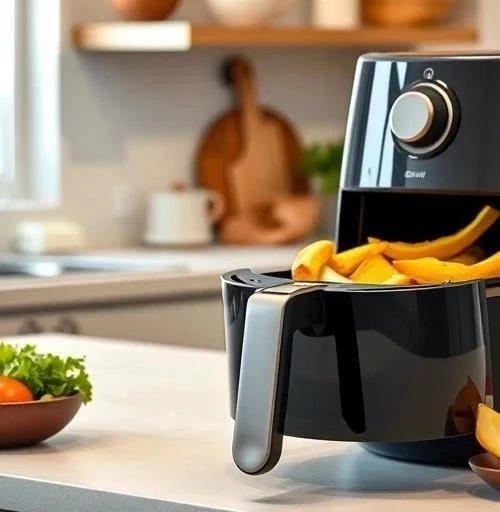
An air fryer is a compact countertop appliance that cooks food by circulating hot air rapidly around it. Despite its name, it does not usually fry food in a deep pool of oil. Instead, a heating element warms the air while a fan drives it around a basket, tray, or small cooking chamber. The moving heat browns and crisps the food’s surface, much as it does in a convection oven.
The name can be misleading, but the appliance is not merely a miniature deep fryer. It is best understood as a small, powerful convection cooker designed for convenient, relatively quick cooking. Its strengths are real, though they depend on the food, the model, and the amount being cooked.
How does it work?
Most basket-style models have a heating element above a removable perforated basket. The fan pushes hot air around the food, while openings let air reach its underside. Some models are built more like small toaster ovens, with shelves, a door, and several cooking levels. Both types rely mainly on hot-air circulation; the exact airflow and temperature control vary by design.
Because the cooking space is small, it can heat up quickly and put food close to the circulating air. This often shortens cooking time compared with a full-size oven, especially for small portions. However, it is not accurate to promise that every air fryer cooks two or three times faster. Results depend on the recipe, the appliance, and whether the oven needs to preheat. A large oven may also be more efficient when preparing several trays at once.
What can you cook in it?
An air fryer is useful for foods that benefit from a browned or crisp exterior: potatoes, vegetables, chicken pieces, fish fillets, frozen snacks, and reheated leftovers. Many models can also roast, bake, grill, or dehydrate, although those labels do not mean they perform exactly like full-size specialist appliances. Small cakes and other baked dishes are possible if they fit safely in the cooking chamber.
For a crisp result, arrange food in a fairly even layer and leave room for air to move around it. Crowding the basket traps moisture and can leave food unevenly cooked. Turning or shaking food partway through cooking may help, though some recipes and appliances need less intervention. A light coating of oil can improve browning; usually, a deep bath of oil is unnecessary. Wet batters are often a poor choice because they can drip before they set.
Air fryer, oven, or deep fryer?
Compared with a conventional oven, an air fryer is smaller and often more convenient for one or two portions. It may need less preheating and can crisp a small batch effectively. The trade-off is capacity: a crowded basket cooks less evenly, and multiple batches can cancel out the time saved. A full-size oven is generally better for large dishes, several trays, or family-sized baking.
A deep fryer cooks food by immersing it in hot oil, producing a characteristic texture and flavor. An air fryer cannot reproduce that result in every case. It can, however, make some foods crisp with much less added oil. That may reduce the fat contributed by cooking oil, but it does not automatically make every dish nutritious: ingredients, portions, salt, and toppings still matter.
An oven’s “air fry” setting uses a similar principle, usually with a fan and a suitable tray. A separate countertop air fryer differs mainly in its compact chamber, basket design, and airflow, not in a completely new method of cooking. Whether it is worthwhile depends on how often you cook small portions and whether you value the convenience enough to give it counter or cupboard space.
Advantages and limitations
- Convenience: The appliance is simple to operate and can be quick for everyday portions.
- Less added oil: Many foods can brown without being submerged in fat, though a little oil may improve texture.
- Compact cooking: It is useful where a full-size oven is unavailable or inefficient for a small meal.
- Limited capacity: A small basket may require batches, and overcrowding compromises results.
- Different texture: Air-fried food can be crisp, but it may be drier or less rich than food prepared with another method.
- Cleaning and noise: Baskets need regular washing, and the fan produces some operating noise.
Safety and care matter too. Place the appliance on a stable, heat-resistant surface, keep its vents clear, and follow the manufacturer’s instructions about accessories and maximum fill. Use oven-safe cookware only when the manual permits it. Let removable parts cool before washing, and avoid abrasive tools or sprays that can damage a non-stick coating. The exterior and exhaust air can become hot, so leave space around the unit.
How to choose one
Start with capacity and the number of people you usually cook for, rather than choosing by a large list of preset programs. Check the basket’s usable area, overall dimensions, temperature range, ease of cleaning, and replacement-part availability. A simple model may be sufficient if you mainly cook frozen snacks or vegetables; an oven-style design can be more practical for multiple items, but it may take up more space. Presets are convenient, yet they do not replace checking whether food is thoroughly cooked.
The bottom line
An air fryer is a compact convection cooker, not a magic device that fries without heat or transforms every meal into health food. It is most valuable for quick, small portions that benefit from a crisp surface and for kitchens where using a large oven feels wasteful. It is less compelling if you routinely cook for many people, already use a convection oven, or expect the exact taste of deep-fried food. In other words, it is a practical tool—not a universal replacement for an oven, stovetop, or fryer.



7 Comments. Оставить новый
The examples of foods that benefit from a crisp exterior make the explanation more concrete. The reminder that an air fryer may not perform like a specialist appliance is also a sensible qualification.
I appreciate the balanced discussion of cooking speed. Rather than making a blanket claim, the article notes that results depend on the recipe, appliance, and batch size, which is useful practical context.
The article does a good job correcting the misleading idea that an air fryer uses deep-frying. Explaining it as a compact convection cooker gives readers a more accurate picture of how it works.
This is a clear introduction for someone unfamiliar with air fryers. The explanation of how a fan moves hot air around the food makes the basic cooking process easy to understand.
The article appropriately points out that a full-size oven can be more efficient for several trays of food. That caveat helps readers think about portion size rather than assuming an air fryer is always the better option.
The comparison between basket-style and oven-style models is helpful for readers deciding what kind might suit their kitchen. It also avoids implying that every model has identical airflow or temperature control.
The article is informative without overselling the appliance. Its distinction between the convenience of a small cooking chamber and the limits of that chamber gives readers a realistic basis for deciding whether one would be useful.