
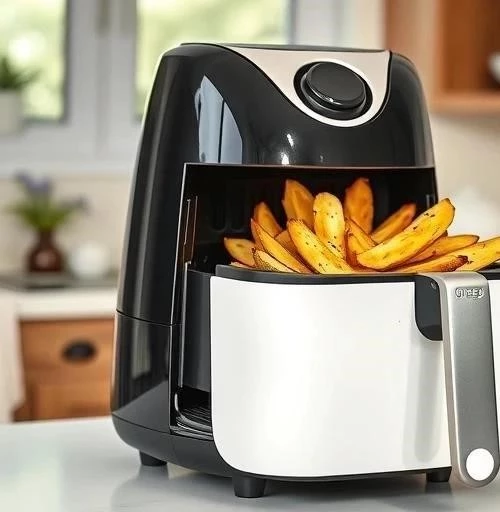
An air fryer is a compact kitchen appliance that cooks food by circulating hot air around it at high speed. Despite its name, it does not usually fry food in the traditional sense: conventional deep-frying cooks ingredients in hot oil, while an air fryer relies mainly on heated air. A small amount of oil may be added for flavor and browning, but many foods can be prepared with little or none.
How does it work?
Most air fryers contain a heating element and a fan. The element warms the air, and the fan moves it around the food inside a cooking chamber or perforated basket. This rapid circulation helps heat food relatively evenly and encourages a browned, crisp surface. The design is similar in principle to a small convection oven, though models differ in shape, capacity, controls, and airflow.
Food needs room for hot air to move around it. Overfilling the basket can block circulation, leaving some pieces pale or soft. Shaking or turning food during cooking can improve the result, especially when the pieces are piled together.
What can you cook in it?
An air fryer is useful for foods that benefit from a dry, browned exterior: potatoes, vegetables, chicken, fish, and some frozen snacks. It can also reheat leftovers, often restoring crispness more effectively than a microwave. Depending on the model, it may bake small portions of pastries or cook other simple dishes. However, it is not a universal replacement for an oven or stovetop. Large meals, delicate batters, and dishes that need substantial liquid may be better suited to other methods.
Advantages—and limitations
- Less added oil: Many recipes need only a light coating, which can reduce the amount of oil used compared with deep-frying.
- Convenience: The appliance heats quickly, uses straightforward controls, and can be easier to manage than a pan of hot oil.
- Texture: Circulating heat can make suitable foods crisp outside while keeping their interiors moist.
- Limited capacity: A small basket may require cooking in batches, so it is not always the fastest option for a family-sized meal.
- Variable results: Cooking time and crispness depend on the appliance, food quantity, and recipe. “Air-fried” does not guarantee the same texture as deep-fried.
It is also worth distinguishing reduced oil use from an automatic health benefit. The nutritional value still depends on the ingredients, portion size, and overall meal. An air fryer can make it easier to cook vegetables or prepare foods with less added fat, but it does not make every processed snack nutritious.
Choosing and using one
Before buying, consider how many people you usually cook for, how much counter space you have, and whether you prefer a basket model or an oven-style model with shelves. A larger appliance can handle more food at once, but it takes up more room. Useful features include a removable dishwasher-safe basket, clear temperature settings, and easy-to-clean surfaces; extra programs are helpful only if you will use them.
For better results, avoid crowding the basket, check food before the suggested cooking time ends, and follow the manufacturer’s guidance. Clean away grease and crumbs regularly, and place the appliance on a stable, heat-resistant surface with space around its vents.
Bottom line
An air fryer is essentially a small, fast-circulating convection cooker designed for convenient browning and crisping. It can reduce the need for added oil and work especially well for modest portions of suitable foods. Its value depends on your cooking habits: it is a practical addition for quick meals and reheating, but not a magic fryer or a replacement for every kitchen appliance.


5 Comments. Оставить новый
The article gives a balanced account by describing both suitable foods and situations where another cooking method may work better. That keeps the guidance informative without presenting the air fryer as a universal replacement.
The explanation clearly distinguishes air frying from traditional deep-frying, which helps set realistic expectations. Comparing the appliance to a small convection oven also makes its basic operation easy to understand.
The section headings make the article easy to scan, while the descriptions of airflow and food texture provide enough explanation to be useful. Including differences among models is also a good reminder that cooking results may vary.
The discussion of using less oil is appropriately qualified: it notes that many foods need little or none, rather than implying that every recipe will be oil-free. This makes the health-related point more measured.
The practical advice about not overfilling the basket is especially useful. Explaining how crowded food blocks airflow connects the cooking method to a common reason results can turn out uneven.