
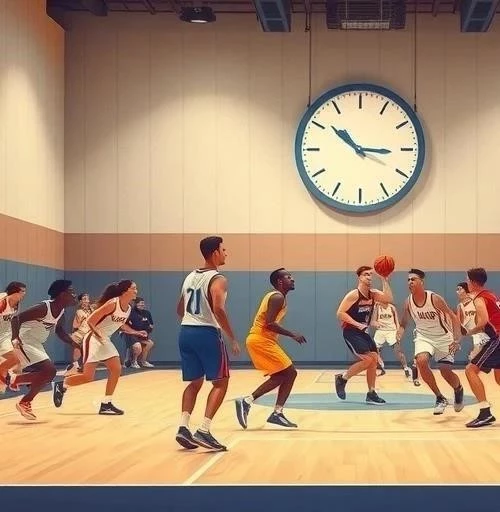
Short answer: the clock time depends on the rules of the competition, but the time spectators spend at the arena or watching a broadcast is usually much longer. A standard professional game has between 40 and 48 minutes of scheduled playing time. Because the clock stops repeatedly, a typical match often takes around two hours in real time, and close or heavily interrupted games can last longer.
Playing time depends on the rules
Basketball does not have one universal game length. Different leagues divide regulation time into periods of different durations. Under FIBA rules, used in international competitions and many national leagues, a game consists of four 10-minute quarters: 40 minutes in total. NBA games have four 12-minute quarters, giving 48 minutes of regulation play.
College basketball in the United States has its own format. Men’s games are generally played in two 20-minute halves, while women’s games use four 10-minute quarters. School, youth, and recreational competitions may use shorter periods, running clocks, or local rules. So, to answer the question accurately, first check which competition is being played.
| Competition or format | Regulation playing time |
|---|---|
| FIBA and many national leagues | 4 × 10 minutes = 40 minutes |
| NBA | 4 × 12 minutes = 48 minutes |
| U.S. men’s college basketball | 2 × 20 minutes = 40 minutes |
| U.S; women’s college basketball | 4 × 10 minutes = 40 minutes |
Why the real-time match takes longer
The scheduled time is not the same as the time on a viewer’s watch. In basketball, the game clock pauses during many stoppages: when the ball goes out of bounds, a foul is called, a player shoots free throws, a team requests a timeout, or officials review a play. The clock also stops at the end of periods and may pause for substitutions or other administrative decisions.
These breaks are part of the sport, not extra playing time added to the regulation total. However, they stretch the event in real time. A quarter listed as 10 minutes can take considerably longer to complete because those 10 minutes count only while the clock is running. The difference is especially noticeable late in a close game, when teams use timeouts, commit tactical fouls, and take free throws in an effort to control the final possessions.
Halftime and breaks between quarters add further time. Broadcasts may also include commercials, studio analysis, or extended coverage of a review. As a result, a 40-minute FIBA game commonly occupies roughly 1 hour 45 minutes to 2 hours, while an NBA game often takes about 2 to 2½ hours. These are practical estimates, not guarantees: a fast-moving game may finish sooner, while a close contest or a game with many reviews can run longer;
Overtime can extend the game
If the score is tied at the end of regulation, the teams play overtime; Under FIBA and NBA rules, an overtime period lasts five minutes. If the teams are still level when it ends, another overtime is played, and this continues until a winner is determined. Therefore, there is no fixed maximum duration for a tied game. Each additional period adds five minutes of playing time, plus the stoppages and break around it.
Overtime is not included in the standard regulation figures. For example, saying that an NBA game has 48 minutes of play describes regulation only; a game that goes to overtime has at least 53 minutes on the clock. Multiple overtime periods can push the total event well beyond its usual length.
What “how long” means
The clearest answer depends on what you want to know. If you mean the official playing time, use the format: 40 minutes for a FIBA game or most college games, and 48 minutes for an NBA game. If you mean how long to set aside to attend or watch, plan for approximately two hours, and allow extra time for a high-stakes game, a long broadcast, or possible overtime.
It is also useful to distinguish playing time from elapsed time. The game clock measures active play and stops according to the rules; a phone or wall clock continues through timeouts, halftime, and other breaks. Confusing these two measures is why a match advertised as “40 minutes” may still occupy close to two hours of someone’s evening.
In brief
- Regulation on the game clock: usually 40 minutes under FIBA rules and 48 minutes in the NBA.
- Typical time in real life: roughly 1¾ to 2½ hours, depending on the league and pace of the game.
- A tie after regulation: leads to five-minute overtime periods until a winner is decided.
- Youth and local games: can be shorter, so check the competition’s rules.
In short, a basketball game is much longer than its official clock suggests. The rules determine the minutes of active play, but timeouts, fouls, halftime, reviews, and overtime determine how long the whole event actually lasts.
5 Comments. Оставить новый
The comparison of FIBA, NBA, and college formats is helpful because it shows why there is no single answer to how long a basketball game lasts. The table makes those differences easy to scan.
The explanation of clock stoppages gives a sound reason for why a game with 40 or 48 minutes of scheduled play can take much longer to watch. The examples of fouls, timeouts, and reviews make the point concrete.
The article clearly distinguishes regulation playing time from the time a game takes in real life. That distinction addresses a common source of confusion and makes the opening explanation useful.
The article is well organized, moving from the different competition rules to the practical experience of watching a match. This structure helps readers understand both the official duration and the longer event time.
The advice to check which competition is being played is a useful takeaway, especially since school and recreational games may follow local rules. The article could be stronger if it completed its final explanation, but the information presented is clear.